

Data Scientist Roadmap: Skills to Learn, Step by Step
A month-by-month data scientist roadmap: Python, pandas, SQL, statistics, ML, the projects to build and how to prepare for data science interviews.
Learning to drive in Indore traffic is a good way to think about this. Nobody starts on the AB Road flyover at rush hour. You first learn the clutch in an empty ground, then quiet lanes in your colony, then busier roads, and only then the highway. Skip the empty ground and you stall at every signal.
Many people who give up on data science skipped the empty ground: a deep learning video on day three, nothing understood, field abandoned. This roadmap orders the steps so each one makes the next easier.
What a data scientist roadmap should do
Mapping the driving lessons:
- The empty ground is Python basics: syntax, loops, functions.
- The colony lanes are data handling: NumPy, pandas and SQL on small tables.
- Busier roads are statistics and EDA: knowing what the numbers mean.
- The highway is machine learning.
- Your driving test is the project portfolio and interview.
A data scientist roadmap is an ordered learning plan where each stage gives you the tools the next stage assumes you already have.
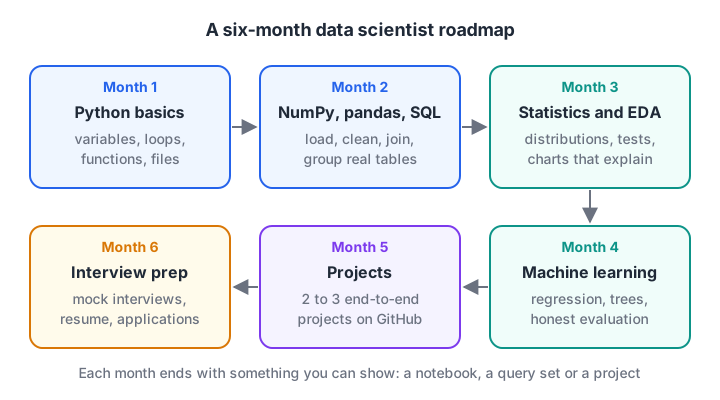
Six stages, roughly one month each for a focused learner. Each month ends with something concrete you can show.
The months are a guide, not a deadline. Stretch a stage if you are working or in college; move on early if it feels easy.
Quick check
What should you learn right after Python basics on this roadmap?
Data handling comes next because every later stage, from statistics to modelling, works on tables you must be able to load and clean.
Months 1 and 2: Python and data handling
Month 1: Python basics
Goal: write small programs without looking up every line.
- Variables, data types and type conversion
- if-else, loops, functions, lists, dictionaries
- Reading and writing files, handling errors
- Writing clean code with clear names and comments
If you have never written code, start with getting started with Python. By the end of the month, you should be able to solve problems like this one without help:
# Month 1 check: count orders per city from raw records, without any library
orders = [
    ("Indore", 450), ("Bhopal", 300), ("Indore", 120),
    ("Ujjain", 220), ("Indore", 380), ("Bhopal", 150),
]

totals = {}
for city, amount in orders:
    totals[city] = totals.get(city, 0) + amount

for city, total in sorted(totals.items(), key=lambda kv: kv[1], reverse=True):
    print(f"{city:<8} {total:>5}")
print("Top city:", max(totals, key=totals.get))
Show at month end: a folder of 20 to 30 small solved exercises.
Month 2: NumPy, pandas and SQL
Goal: load a messy table, clean it and answer questions from it.
- NumPy arrays, vectorisation and masks: see NumPy arrays explained
- pandas selection, filtering,
groupbyand missing values: see the pandas DataFrame tutorial - SQL:
SELECT,WHERE,GROUP BY,JOIN, subqueries and window functions
Give SQL real time: it is often the first technical round in interviews.
Show at month end: a notebook that cleans one public dataset and answers ten questions about it, plus the same answers written in SQL.
Months 3 and 4: Statistics and machine learning
Month 3: Statistics and exploratory data analysis
Goal: describe data honestly and spot patterns worth testing.
- Mean, median, spread, percentiles and the normal distribution: see statistics for data science
- Probability basics, sampling, confidence intervals, hypothesis tests and A/B tests
- Charts with matplotlib or seaborn: histograms, box plots, scatter plots, bar charts
- Writing a short summary of findings for a non-technical reader
Show at month end: an EDA report on a dataset of your choice with five clear findings and the chart behind each one.
Month 4: Machine learning fundamentals
Goal: train, evaluate and explain a model, and know when not to use one.
- Supervised learning: linear and logistic regression, decision trees, random forests
- Train/test splits, cross-validation, baselines and metrics such as accuracy, precision, recall and RMSE
- Feature engineering and scaling
- Unsupervised basics: k-means clustering
Here is the kind of small, complete loop you should be able to write from memory:
from sklearn.datasets import load_iris
from sklearn.model_selection import train_test_split
from sklearn.tree import DecisionTreeClassifier
from sklearn.dummy import DummyClassifier
from sklearn.metrics import accuracy_score

X, y = load_iris(return_X_y=True)
X_tr, X_te, y_tr, y_te = train_test_split(X, y, test_size=0.3, random_state=1, stratify=y)

baseline = DummyClassifier(strategy="most_frequent").fit(X_tr, y_tr)
tree = DecisionTreeClassifier(max_depth=3, random_state=1).fit(X_tr, y_tr)

print("Baseline accuracy:", round(accuracy_score(y_te, baseline.predict(X_te)), 2))
print("Tree accuracy:    ", round(accuracy_score(y_te, tree.predict(X_te)), 2))
print("Most useful feature index:", tree.feature_importances_.argmax())
If you want to go deeper into models specifically, Debugshala's machine learning course in Indore focuses on this stage.
Show at month end: two small models on different problems (one classification, one regression), each compared against a baseline.
Month 5: The projects to build
Goal: two or three end-to-end projects that follow the full data science lifecycle, from problem statement to a usable result.
Pick realistic data and a question someone would pay to answer:
| Project | Question it answers | Skills it shows |
|---|---|---|
| Retail sales forecasting | How much stock should each store order next week? | pandas, time features, regression |
| Customer churn prediction | Which subscribers are likely to leave next month? | classification, imbalanced data, metrics |
| Rental price analysis for Indore localities | Which factors drive rent, and is a listing fairly priced? | data collection, EDA, regression |
| Review sentiment classifier | Are product reviews positive or negative? | text cleaning, basic NLP |
Give each project a one-page README: problem, data, what you tried, what failed and what you would do next. Interviewers often read it before your code.
Show at month end: a GitHub profile with your projects, each with a README and a short demo (a simple Streamlit app or a clear notebook).
Quick check
Which project README detail do interviewers value most?
Explaining your choices and failures shows real understanding, which is what the project round tests.
Month 6: How to prepare for data science interviews
Goal: be able to explain everything on your resume calmly and in detail.
Data science interviews usually mix these rounds:
- Aptitude and reasoning, often online, for freshers.
- SQL and Python: write queries and pandas code live.
- Statistics and ML concepts: bias vs variance, overfitting, choosing a metric, explaining p-values.
- Project discussion: why you chose this approach, what failed, how you would improve it.
- HR round: communication, motivation, relocation.
A typical live-coding question looks like this. Practise solving it first in pandas, then in SQL.
import pandas as pd

# "Find each customer's total spend and return the top 2 spenders."
orders = pd.DataFrame({
    "customer": ["Ravi", "Meera", "Ravi", "Aman", "Meera", "Aman", "Ravi"],
    "amount": [500, 1200, 300, 450, 200, 900, 150],
})

spend = (orders.groupby("customer", as_index=False)["amount"].sum()
               .sort_values("amount", ascending=False))
print(spend.head(2).to_string(index=False))
Prepare a two-minute story per project (problem, data, approach, result, lesson), and do a few mock interviews before applying widely.
For the aptitude round, regular timed practice helps a lot; you can prepare for aptitude rounds on Debugshala Test, which has free aptitude, reasoning and coding quizzes.
Self-study or a classroom course in Indore?
Self-study works if you are disciplined and can judge your own projects honestly. It is free, but slow when you get stuck.
A classroom course adds structure, a fixed schedule, peers working on the same problems and someone to review your projects and mock interviews.
In Indore, Debugshala is an industry-aligned training and placement institute focused on Data, AI and Full Stack Development, with classes at its Old Palasia campus. Its Data Science & AI course is also available online, and teaching is in English and Hindi.
A few points that matter if you are deciding:
- Background: Debugshala's courses accept fresh graduates, non-IT backgrounds and people with a year gap.
- Try first: there is a free demo class before you pay anything.
- After training: placement assistance is offered.
- Related courses: Data Analytics, BI Tools, Generative AI, Machine Learning and Data Engineering are also offered, if your goal is narrower.
You can compare the details on the Data Science & AI course page, or visit the campus at 204-208, C.S. Naidu Arcade, Greater Kailash Road, Opposite Grotto, Old Palasia, Indore.
Common roadmap mistakes
- Starting with deep learning. Without pandas and statistics, neural networks stay a black box.
- Tutorial loops. Watching a fifth Python course instead of building something. Cap tutorials and start a project.
- Skipping SQL. It is tested early and used daily.
Key takeaways
- Follow the order: Python, data handling and SQL, statistics and EDA, machine learning, projects, interviews.
- End each stage with something you can show.
- Build two or three original end-to-end projects with clear READMEs.
- Prepare for SQL, pandas, statistics, ML concepts and project questions, plus aptitude for fresher hiring.
FAQ
How long does it take to become a data scientist from scratch?
It depends on your starting point and daily hours. A focused learner can cover this path in about six months; part-time learners often take longer, which is fine as long as the order stays the same.
Can a non-IT graduate become a data scientist?
Yes. Most entry-level roles need school-level statistics applied carefully, and Python is beginner-friendly. What counts is strong projects. Debugshala's courses accept non-IT backgrounds.
Is there a data science course in Indore with a free demo class?
Yes. Debugshala offers a free demo class before you pay anything for its Data Science & AI course, run at the Old Palasia campus and online. For admissions, call +91-8982385539 or email info@debugshala.com.
What should I learn first, data analytics or data science?
If you want a job sooner and enjoy SQL and dashboards, start with analytics; it covers Months 1 to 3 of this roadmap. If you want to build predictive models, continue to the full data science path. Many people move from analyst to data scientist after a year or two of real work.
From the team behind this site
Go further with the Data Science & AI Course at Debugshala
These tutorials are written by Debugshala, a training and placement institute at Old Palasia, Indore. The classroom course adds live mentoring, real projects and interview preparation.
- Offline classes at Old Palasia, Indore
- Free demo class before you pay
- Non-IT, fresher and year-gap friendly
- Placement assistance
700+ students placed · 200+ hiring partners · 4.9★ Google rating
