

What is Data Science? A Beginner's Guide with Real Examples
Learn what data science is, how it differs from analytics, ML and statistics, with real Indian examples, runnable Python code and the skills you need.
Imagine you run a sweet shop near Sarafa Bazaar. Every evening you note in a register how many plates of jalebi, poha and gajak you sold, and what the weather was like.
After three months, you have about 90 pages of numbers. One day you wonder: "Should I make more gajak on cold evenings?" You flip through the register, count cold days, compare sales, and decide to prepare 40 extra pieces whenever the temperature drops below 15 degrees.
You just did a tiny data science project.
What is data science, in plain words?
Let's map the sweet shop onto the real vocabulary.
- The register is your dataset. Each evening is a row, and each thing you wrote down (date, item, plates sold, temperature) is a column.
- "Should I make more gajak on cold evenings?" is the business question.
- Counting and comparing cold and warm days is analysis.
- "Make 40 extra pieces below 15 degrees" is the decision, the part that actually earns money.
Data science is the practice of using data, statistics and code to answer a real question well enough that someone can act on the answer.
The key word is act. A chart nobody uses, or a model that never reaches the shop counter, is not data science. The job ends when a decision changes.
Quick check
Which of these best marks the end of a data science project?
Accuracy and dashboards are steps along the way. The project delivers value only when someone acts differently.
Data science vs data analytics, machine learning and statistics
These four terms get mixed up all the time. The easiest way to separate them is by the question each one is best at.
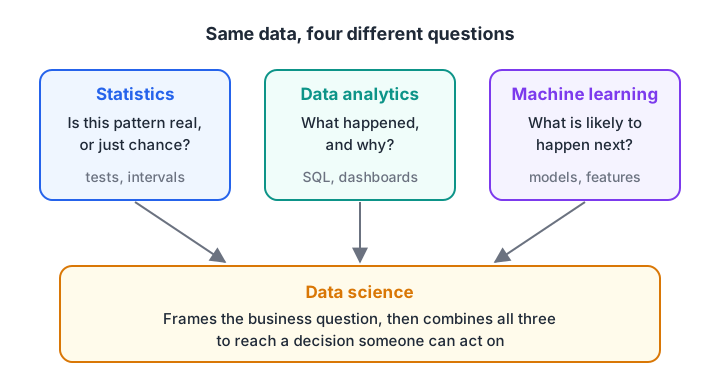
Each neighbouring field answers one kind of question; data science picks whichever ones the business problem needs.
| Field | Main question | Typical output |
|---|---|---|
| Statistics | Is this difference real, or random noise? | A test result, a confidence interval |
| Data analytics | What happened last month, and why? | A report, a dashboard, a SQL query |
| Machine learning | What will happen for this new case? | A trained model that makes predictions |
| Data science | What should we do, given all of the above? | A decision, often backed by a model or analysis |
Here is how the sweet shop question looks through each lens:
- Statistics: gajak sold 52 plates on cold days and 31 on warm days on average. Is that gap big enough to trust, or could it be luck over 90 days?
- Analytics: a monthly report showing sales per item, per weekday, with a note that December was the best month.
- Machine learning: a model that takes tomorrow's forecast temperature and predicts plates sold, say 48.
- Data science: combining all three to set a preparation rule, checking it saves money, and revisiting it next winter.
So data science is not a separate island; it borrows from the other three. In small companies one person does all of it, while large companies split the work across several roles.
Quick check
A shop owner asks, "What will next Sunday's sales be?" Which field is best suited to that question on its own?
Predicting a value for a new, future case is what machine learning models are built for. Data science would then decide what to do with the prediction.
A tiny data science project you can run
Let's turn the sweet shop register into code. You don't need anything installed; the block runs in your browser. If Python itself is new to you, start with your first Python program and come back.
# Ten evenings from the shop register: temperature (deg C) and gajak plates sold
temps = [12, 14, 22, 25, 11, 13, 24, 27, 10, 23]
plates = [55, 50, 30, 28, 58, 49, 33, 26, 60, 31]

cold = [p for t, p in zip(temps, plates) if t < 15]
warm = [p for t, p in zip(temps, plates) if t >= 15]

print("Cold evenings:", len(cold), "average plates:", sum(cold) / len(cold))
print("Warm evenings:", len(warm), "average plates:", sum(warm) / len(warm))
print("Extra plates on cold days:", sum(cold) / len(cold) - sum(warm) / len(warm))
That is the analytics part: what happened. Cold evenings sold about 25 more plates. Now let's add a small predictive step with scikit-learn, the most common machine learning library in Python.
from sklearn.linear_model import LinearRegression

temps = [[12], [14], [22], [25], [11], [13], [24], [27], [10], [23]]
plates = [55, 50, 30, 28, 58, 49, 33, 26, 60, 31]

model = LinearRegression().fit(temps, plates)
print("Plates lost per degree warmer:", round(-model.coef_[0], 2))

for forecast in [9, 16, 26]:
    guess = model.predict([[forecast]])[0]
    print(f"Forecast {forecast} C -> prepare about {round(guess)} plates")
Every extra degree costs roughly two plates. The data science part is acting on that: prepare stock from the forecast, track waste for a month, and check the rule saved money.
Real examples of data science in India
Data science sounds abstract until you notice it in apps you already use.
- Food delivery: the estimated delivery time on your order is a prediction built from distance, restaurant prep history, traffic and rider availability.
- UPI fraud checks: banks score every transaction in milliseconds. An unusual amount, a new device and a late-night hour together can trigger an extra check.
- E-commerce recommendations: "customers who bought this also bought" is a pattern mined from millions of past baskets.
- Retail stock planning: a chain of stores in Indore deciding how much to stock before Diwali is solving the sweet shop problem at a bigger scale.
Every example starts with a decision (dispatch a rider, block a payment, order stock) and works backwards to the data.
Skills you need to become a data scientist
You don't need a computer science degree. You do need a mix of four skill groups.
Programming with Python
Python is the default language for data work. You need comfort with variables, loops, functions and lists, then the data libraries on top: NumPy for numbers and pandas for tables. Our guide to NumPy arrays is a good next step after the basics.
Statistics and maths
You need averages, spread, distributions, correlation and the idea of sampling. Most daily work uses school-level maths applied carefully, not advanced calculus. The statistics for data science tutorial covers the essentials with code.
Data handling and SQL
Real data lives in databases and spreadsheets, and it is messy. Expect to spend much of your time joining tables, fixing dates and filling gaps. Most jobs require SQL.
Business sense and communication
Beginners skip this one. You must turn "reduce wastage" into a measurable target, then explain the result to a manager who has no interest in your code.
# A quick self-check: how ready are you? Score 0-3 for each skill.
skills = {"Python": 2, "Statistics": 1, "SQL": 0, "Communication": 2}

total = sum(skills.values())
weakest = min(skills, key=skills.get)
print(f"Readiness: {total} out of {3 * len(skills)}")
print("Start with:", weakest)
for name, score in sorted(skills.items(), key=lambda kv: kv[1]):
    print(f"{name:<14}{'#' * score}{'.' * (3 - score)}")
If you would rather learn these skill groups in a classroom than alone, Debugshala's data science course is taught in classrooms at Old Palasia, Indore, and also online.
Common mistakes beginners make
- Starting with the model. People jump to deep learning before asking what decision the result will change. Start from the question.
- Trusting the data blindly. A temperature column with values like 250 is a typo, not a heatwave. Always look at minimums, maximums and missing values first.
- Confusing correlation with cause. Ice cream sales and drowning cases rise together because both rise in summer, not because one causes the other.
Key takeaways
- Data science turns data into decisions using statistics, programming and domain knowledge.
- Statistics checks whether patterns are real, analytics explains the past, machine learning predicts, and data science combines them around a business question.
- You can start with plain Python and lists, then move to pandas, statistics and simple models.
- The four skill groups are Python, statistics, data handling with SQL, and communication.
- Always begin with the decision and work backwards to the data.
FAQ
Is data science hard to learn for a non-IT student?
It is learnable if you go step by step. The maths is mostly averages, percentages and simple probability, and Python is one of the friendliest first languages. Commerce, science and arts graduates make the switch regularly; consistent practice matters more than your degree.
What is the difference between a data scientist and a data analyst?
A data analyst mostly explains what already happened, using SQL, spreadsheets and dashboards. A data scientist also builds predictive models and experiments, and usually writes more code. Many people start as analysts and grow into data science.
Do I need to learn machine learning before data science?
No. Machine learning is one part of data science, and it comes after Python, data handling and statistics. Models are hard to use on real data if you cannot clean a table first.
Can I learn data science in Indore with classroom support?
Yes. Debugshala runs a Data Science & AI course at its Old Palasia campus in Indore, with teaching in English and Hindi, and the same course is also available online. You can attend a free demo class before you pay anything, and freshers, non-IT graduates and people with a year gap can join. For admissions, call +91-8982385539 or email info@debugshala.com.
How can I practise data science questions for free?
Run every code block on this site and change the numbers to see what happens. For quizzes on aptitude, reasoning and coding, you can practise MCQs on Debugshala Test, which helps when you prepare for interviews.
From the team behind this site
Go further with the Data Science & AI Course at Debugshala
These tutorials are written by Debugshala, a training and placement institute at Old Palasia, Indore. The classroom course adds live mentoring, real projects and interview preparation.
- Offline classes at Old Palasia, Indore
- Free demo class before you pay
- Non-IT, fresher and year-gap friendly
- Placement assistance
700+ students placed · 200+ hiring partners · 4.9★ Google rating
