

AI vs ML vs Deep Learning: Differences and Types of Learning
AI vs ML vs deep learning explained with a nested-circles diagram, plus supervised, unsupervised and reinforcement learning labs you can run in Python.
Imagine your aunt runs a small sweet shop in Sarafa. For years she has priced her poha-jalebi combo with a rule on a sticky note: "If it is Sunday, add 10 rupees." That sticky note is a program. Someone wrote the rule; the shop just follows it.
Now imagine she hands her nephew three years of sales notebooks and says, "Work out the pricing yourself." He studies the numbers and notices that rainy evenings, wedding season and cricket match days all change demand. Nobody told him those rules. He found them in the data.
Finally, imagine he is so good at this that he can look at a photo of the queue outside and guess how many plates will sell in the next hour. He is no longer reading neat columns; he is reading raw pixels and building up his own layers of understanding.
Those three scenes are the whole story of this article.
AI vs ML vs Deep Learning: The Nested Circles
Map the shop to the jargon. The overall wish, "make the shop behave smartly", is artificial intelligence. The nephew learning pricing rules from notebooks is machine learning. The nephew reading photos through layers of perception is deep learning.
Artificial intelligence is the field of building systems that perform tasks we would call intelligent; machine learning is the part of AI where the system learns those behaviours from data; deep learning is the part of ML that uses neural networks with many layers.
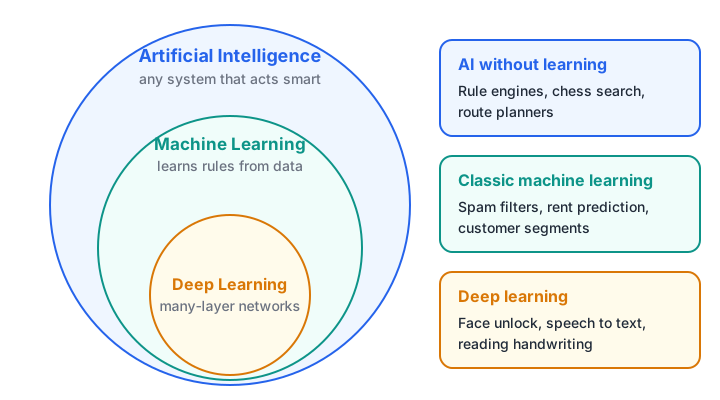
Each circle is a subset of the one around it: all deep learning is machine learning, and all machine learning is AI, but not the other way round.
Read the circles from the outside in:
- AI (outer circle) includes things that do not learn at all: a chess engine searching moves, a rule-based chatbot, a route planner in a maps app. They look smart because a human encoded the smartness.
- ML (middle circle) replaces hand-written rules with patterns learned from examples. Spam filters, loan-risk scores and price predictors live here.
- Deep learning (inner circle) stacks many layers of artificial neurons so the model can learn its own features from raw input such as images, audio or text. Face unlock and speech-to-text live here.
A rule vs a learned rule, in code
The quickest way to feel the difference is to write both. The first function is "AI by hand". The second one is ML: it looks at examples and picks the threshold itself.
# Hand-written rule (classic AI): a human chooses the number 30
def rule_based(temp_c):
    return "sell cold lassi" if temp_c > 30 else "sell hot chai"

# Learned rule (ML): try every threshold, keep the one with fewest mistakes
temps  = [18, 22, 25, 27, 29, 31, 33, 35, 38, 40]
best   = ["chai", "chai", "chai", "chai", "lassi", "lassi", "lassi", "lassi", "lassi", "lassi"]

def errors(threshold):
    return sum((t > threshold) != (b == "lassi") for t, b in zip(temps, best))

learned = min(range(15, 41), key=errors)
print("Human rule threshold: 30")
print("Learned threshold:", learned, "with", errors(learned), "mistakes")
print("Rule says at 29C:", rule_based(29))
In this data lassi starts winning at 29°C, so the search lands on 27 with zero mistakes. The human guessed 30 and tells you to sell hot chai on a 29°C afternoon, which the notebook says is wrong. That one small gap is why ML exists: data notices what people miss.
Quick check
Which statement about AI, ML and deep learning is true?
Deep learning sits inside the machine learning circle, which sits inside AI. Many AI systems, like rule engines, do not learn at all.
The Three Types of Machine Learning
Once you are inside the ML circle, the next question is what kind of signal does the model learn from? There are three common answers.
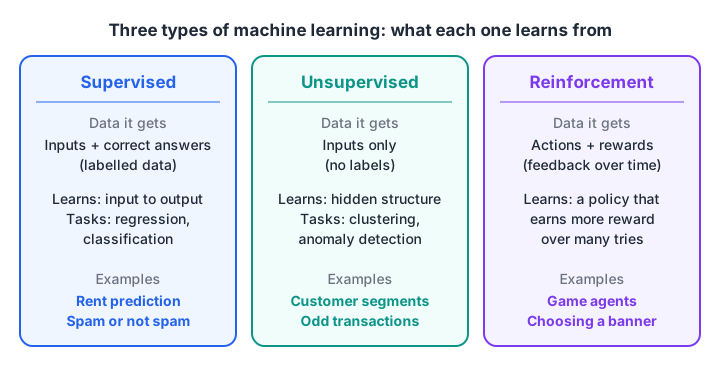
The three types of machine learning differ in the feedback they get: correct answers, no answers, or rewards after actions.
Supervised learning: learning with an answer key
You give the model inputs and the correct outputs, like a student practising with a solved answer key. It learns a mapping from input to output, then predicts for new inputs.
- Predicting a flat's rent in Vijay Nagar from its size and floor (a number: regression).
- Marking an email as spam or not spam (a category: classification).
- Checking whether a loan applicant is likely to repay.
from sklearn.linear_model import LogisticRegression

# hours studied, practice tests taken -> passed exam (1) or not (0)
X = [[1, 0], [2, 1], [3, 1], [4, 2], [5, 2], [6, 3], [7, 4], [8, 4], [2, 0], [6, 2]]
y = [0, 0, 0, 1, 1, 1, 1, 1, 0, 1]

model = LogisticRegression().fit(X, y)
for student in [[1, 1], [4, 1], [7, 3]]:
    p = model.predict_proba([student])[0][1]
    print(f"{student} -> pass probability {p:.2f}")
The model was never told "four hours is the line". It inferred it from ten labelled rows.
Unsupervised learning: finding groups with no answer key
Here you only have inputs. There is no "correct" column. The model looks for structure: groups, outliers or a simpler way to describe the data.
- Grouping shoppers at a Treasure Island store by spending pattern (clustering).
- Flagging an unusual card transaction (anomaly detection).
- Squeezing 50 survey questions into 3 underlying themes (dimensionality reduction).
import numpy as np
from sklearn.cluster import KMeans

# monthly visits, average bill in rupees (no labels anywhere)
customers = np.array([[2, 300], [3, 350], [2, 280], [12, 400], [14, 450],
                      [13, 420], [4, 2500], [3, 2700], [5, 2600]])
km = KMeans(n_clusters=3, n_init=10, random_state=0).fit(customers)
for c in range(3):
    group = customers[km.labels_ == c]
    print(f"Group {c}: {len(group)} customers, avg visits {group[:,0].mean():.1f}, avg bill {group[:,1].mean():.0f}")
KMeans finds three kinds of customer: occasional small spenders, frequent regulars and rare big spenders. The business names them; the algorithm only groups them.
Reinforcement learning: learning from rewards
An agent takes an action, the environment gives a reward, and the agent slowly prefers actions that pay off. Nobody labels the right move in advance. Think of a child learning to ride a cycle: wobble, fall, adjust.
- Game-playing agents that learn by playing millions of rounds.
- A warehouse robot learning an efficient path.
- Choosing which of three app banners to show so that clicks go up.
import random
random.seed(1)

true_click_rate = {"banner_A": 0.05, "banner_B": 0.12, "banner_C": 0.08}  # hidden from agent
shown  = {b: 0 for b in true_click_rate}
clicks = {b: 0 for b in true_click_rate}

for visitor in range(3000):
    if random.random() < 0.1:                      # explore 10% of the time
        b = random.choice(list(true_click_rate))
    else:                                          # exploit the best so far
        b = max(shown, key=lambda k: clicks[k] / shown[k] if shown[k] else 1)
    shown[b] += 1
    clicks[b] += random.random() < true_click_rate[b]

for b in shown:
    print(b, "shown", shown[b], "times, observed rate", round(clicks[b] / shown[b], 3))
The agent ends up showing banner B most, because that is where the rewards came from. This tiny loop (an epsilon-greedy bandit) is the seed of reinforcement learning.
Quick check
A spam filter trained on 50,000 emails already marked spam or not spam is an example of:
The training data includes the correct answer (spam or not), so it is supervised classification.
Quick check
You have shop data with no labels and want to discover kinds of customers. What should you try first?
With no labels and a goal of finding groups, clustering (unsupervised learning) is the natural first step.
When to Use Which Type of Learning
Start from your data and the decision you need, not from the algorithm you find exciting.
| Your situation | Use | Example |
|---|---|---|
| You have past examples with the correct answer | Supervised | Predict next month's demand from past sales |
| You have data but no labels, and want structure | Unsupervised | Segment 10,000 customers into groups |
| An agent acts repeatedly and gets a score | Reinforcement | Tune which offer to show each visitor |
| The rule is simple and stable | No ML at all | GST calculation, age checks |
| Inputs are raw images, audio or long text | Deep learning (usually supervised) | Read handwritten forms |
Two practical rules help:
- If a clear rule works, write the rule. ML is for problems where the rule is fuzzy or keeps changing.
- Labels are the expensive part. If you have 500 labelled rows and 500,000 unlabelled ones, a common approach is to cluster or explore first, then label smartly.
Where deep learning fits
Deep learning is not a fourth type. It is a model family you can use inside any of the three. A neural network can be trained supervised (image classification), unsupervised (autoencoders) or with rewards (game agents). You will build one by hand in the neural network from scratch lab.
For tabular data such as sales sheets, simpler models like decision trees often match or beat deep networks and are far easier to explain to a manager.
Common Mistakes Beginners Make
- Using "AI" and "ML" as synonyms. In interviews, say which one you mean. A rule engine is AI but not ML.
- Assuming deep learning is always better. On a 2,000-row spreadsheet it usually adds complexity, training time and overfitting risk.
- Calling clustering "prediction". Clusters describe your data; they do not come with correct answers to check against.
- Forgetting the baseline. Before training any model, check how a simple rule performs. If the rule gets 90% right, your model must beat that.
- Skipping Python basics. If loops or lists still feel shaky, revise the for loop tutorial first. Every lab here uses them.
If you prefer to learn these ideas with a mentor and a batch of classmates, a hands-on ML programme taught at Debugshala covers the same path from rules to models with hands-on labs.
Key takeaways
- AI is the goal, ML learns the behaviour from data, and deep learning is ML with many-layered neural networks.
- Supervised learning needs labelled examples; unsupervised learning finds structure without labels; reinforcement learning learns from rewards after actions.
- Choose the type from what your data looks like and what decision you need to make.
- Deep learning is a model family, not a learning type, and it shines on raw images, audio and text.
- Always compare against a simple rule or baseline before trusting a model.
FAQ
Is machine learning the same as artificial intelligence?
No. Machine learning is a subset of AI. AI also includes systems built from hand-written rules and search, such as chess engines or rule-based chatbots, that never learn from data. All ML is AI, but not all AI is ML.
Do I need deep learning to get an ML job as a fresher?
Most entry-level roles test core ML first: data handling, supervised models, evaluation and explaining results. Deep learning is valuable, but interviewers usually check whether you understand train/test splits and metrics before neural network architectures. Learn the foundations, then go deeper.
What are real examples of reinforcement learning?
Game-playing agents, robot control, recommendation and ad systems that adapt to clicks, and some traffic-signal and energy-management research. In business settings, the simplest form, choosing between options based on observed rewards, is the most common starting point.
Can I learn machine learning in Indore without an IT background?
Yes. Debugshala, an IT training and placement institute at Old Palasia, Indore, accepts fresh graduates, people from non-IT backgrounds and those with a year gap. Classes are taught in English and Hindi, and you can attend a free demo class before paying anything. Placement assistance is offered.
Which should I learn first: AI, ML or deep learning?
Start with Python, then core machine learning (supervised and unsupervised models plus evaluation), then deep learning. Each layer builds on the one before, the same way the circles nest. You can practise along the way with the coding and aptitude quizzes on Debugshala Test.
From the team behind this site
Go further with the Data Science & AI Course at Debugshala
These tutorials are written by Debugshala, a training and placement institute at Old Palasia, Indore. The classroom course adds live mentoring, real projects and interview preparation.
- Offline classes at Old Palasia, Indore
- Free demo class before you pay
- Non-IT, fresher and year-gap friendly
- Placement assistance
700+ students placed · 200+ hiring partners · 4.9★ Google rating
