

Machine Learning Projects for Beginners (with a Portfolio Plan)
10 machine learning projects for beginners with dataset types, skills and difficulty, plus a GitHub README template and LinkedIn plan to land interviews.
Think of two candidates walking into a placement drive at an Indore college. The first says, "I know Python, pandas, scikit-learn and machine learning." The interviewer nods and moves on. Every resume in the pile says the same thing.
The second says, "I built a model that predicts flat rents in Indore localities. A simple average was off by about Rs 3,000; my model gets within about Rs 1,000. Here is the GitHub link." The interviewer leans in and asks how she handled missing values.
Same skills on paper. The difference is evidence. A project is a small, checkable story that proves you can take a messy question to a working answer.
What Makes a Good Beginner ML Project
Map the placement drive to your portfolio. The interviewer is a busy reader with two minutes. Your project is the proof. Your README is the pitch. Your metric against a baseline is the headline.
A good beginner machine learning project answers one clear question with real or realistic data, compares a model against a simple baseline using a sensible metric, and explains the result in plain language.
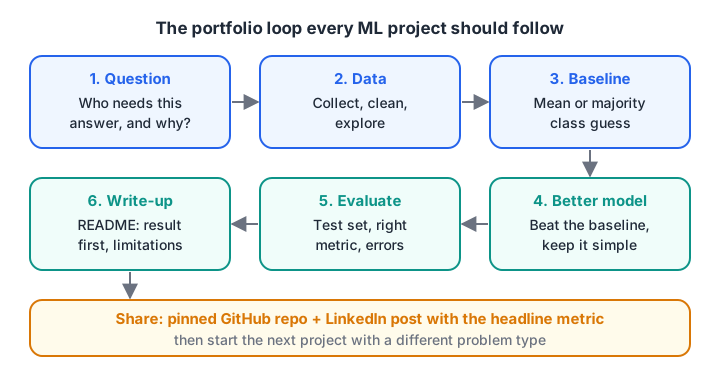
Every portfolio project follows the same six-step loop. Recruiters look for the baseline, the metric and the write-up, not just the model.
Three qualities matter more than the algorithm you use:
- A question someone would pay to answer. "Which customers will cancel next month?" is better than "apply KNN to a dataset".
- Honest evaluation. A held-out test set and the right metric, explained in the model evaluation metrics guide.
- Clarity. A stranger should understand the result from your README in under a minute.
10 Machine Learning Project Ideas for Beginners
The list moves from easy to harder. Do them in order and you will touch regression, classification, clustering, text and time series by the end.
| # | Project | Dataset type | Main skills | Difficulty |
|---|---|---|---|---|
| 1 | Flat rent predictor for city localities | Tabular, numeric and categorical | Regression, encoding, MAE/RMSE | Easy |
| 2 | Student exam pass/fail predictor | Tabular, small | Logistic regression, train/test split | Easy |
| 3 | Loan approval classifier | Tabular, imbalanced | Precision/recall, decision trees | Easy |
| 4 | Customer segmentation for a retail store | Tabular, unlabelled | KMeans, scaling, profiling clusters | Easy to medium |
| 5 | Telecom or broadband churn prediction | Tabular, imbalanced | Feature engineering, threshold tuning, ROC-AUC | Medium |
| 6 | SMS or email spam filter | Short text | TF-IDF, Naive Bayes, confusion matrix | Medium |
| 7 | Product review sentiment classifier | Text with labels | Text cleaning, logistic regression, F1 | Medium |
| 8 | Daily sales forecaster for a shop | Time series | Lag features, time-based split, MAE | Medium |
| 9 | Handwritten digit recogniser | Small images (8×8 pixels) | Neural networks, scaling, accuracy per class | Medium |
| 10 | Credit card fraud detector | Tabular, highly imbalanced | Resampling, recall at fixed precision, cost analysis | Medium to hard |
How to pick your first three
Choose one regression (project 1 or 8), one classification (2, 3, 5 or 10) and one non-tabular project (4, 6, 7 or 9). That spread shows range without spreading you thin.
Public datasets for most of these exist on open data portals and in scikit-learn itself (load_digits for project 9, for example). If you collect local data, such as rent listings you note down yourself, say so in the README; original data is a talking point.
Where each idea teaches something specific
- Projects 1 and 2 teach the full loop with almost no friction. Finish one within a week.
- Project 3 is where you discover that accuracy hides problems. Pair it with the decision trees lab so you can explain each rule.
- Project 4 has no right answer, so the skill is naming and describing clusters in business language.
- Projects 6 and 7 introduce text, where turning words into numbers is half the work.
- Project 8 forces a date-based split. Random shuffling here is a classic mistake interviewers ask about.
- Project 9 is a gentle neural network project. Build the intuition first in the neural network from scratch lab.
- Project 10 brings everything together: imbalance, threshold choice and the cost of each mistake.
Quick check
What should the first lines of a project README contain?
Busy readers decide in seconds. Lead with what the project does and how well it does it.
Lab: The Baseline-First Template
Every project should start the same way: beat a dumb baseline before you claim success. This script builds a realistic inline rent dataset, compares three models and prints the result as a Markdown table you can paste straight into your README.
import numpy as np
from sklearn.model_selection import train_test_split
from sklearn.dummy import DummyRegressor
from sklearn.linear_model import LinearRegression
from sklearn.ensemble import RandomForestRegressor
from sklearn.metrics import mean_absolute_error

rng = np.random.default_rng(3)
n = 300                                          # flats: size, bedrooms, floor, metro distance
size = rng.integers(400, 1800, n)
beds = np.clip(size // 450, 1, 4)
floor = rng.integers(0, 12, n)
metro_km = rng.uniform(0.2, 8, n)
rent = 6 * size + 1500 * beds + 150 * floor - 900 * metro_km + rng.normal(0, 1500, n)
X = np.column_stack([size, beds, floor, metro_km])

X_tr, X_te, y_tr, y_te = train_test_split(X, rent, test_size=0.2, random_state=0)
models = {"baseline (mean rent)": DummyRegressor(),
          "linear regression": LinearRegression(),
          "random forest": RandomForestRegressor(n_estimators=50, random_state=0)}
print("| model | test MAE (Rs) |")
print("|---|---|")
for name, m in models.items():
    mae = mean_absolute_error(y_te, m.fit(X_tr, y_tr).predict(X_te))
    print(f"| {name} | {mae:,.0f} |")
The baseline misses by about Rs 3,000 on average. Linear regression gets that down to roughly Rs 1,050, and the random forest lands near Rs 1,200. The fancier model lost, because this data has a mostly straight-line relationship.
Write that finding in your README. "I tried a random forest, but linear regression was both simpler and more accurate" shows judgement, which interviewers value more than a long list of algorithms.
Quick check
Your random forest scores slightly worse than linear regression on the test set. What should you do in the write-up?
Honest comparison and sound model choice show judgement, which is what interviewers look for.
How to Present ML Projects on GitHub
One repository per project
Keep each project in its own repository with a short, descriptive name such as indore-rent-predictor. Use this structure:
indore-rent-predictor/
├── README.md          # the pitch: problem, result, how to run
├── data/              # small sample or a link to the source
├── notebooks/         # exploration, cleaned and in order
├── src/               # reusable functions (cleaning, training)
├── requirements.txt   # exact library versions
└── results/           # metric table, one or two charts
A README recruiters actually read
Put the result at the top, not the bottom:
# Indore Rent Predictor
Predicts monthly flat rent from size, bedrooms, floor and distance to transport.

Result: test MAE of about Rs 1,050 vs Rs 3,075 for a mean-rent baseline.

## Problem        why this matters and who would use it
## Data           source, rows, columns, what you cleaned
## Approach       baseline, models tried, why you chose the final one
## Results        metric table, one chart, what the errors look like
## Limitations    what the model cannot do, what you would try next
## How to run     pip install -r requirements.txt, then one command
The Limitations section is the most underrated. Saying "the model struggles above Rs 40,000 because few luxury flats are in the data" proves you looked at your errors.
GitHub hygiene that signals professionalism
- Clear commit messages ("add date-based split", not "update").
- No giant raw data files; link to the source instead.
- A pinned set of your best three repositories on your profile.
- Notebooks that run top to bottom without errors. Restart and run all before pushing.
How to Share ML Projects on LinkedIn
A LinkedIn post is a trailer for the repository. Aim for one post per finished project:
- Hook with the result: "A mean-rent guess was off by about Rs 3,000. My model gets within about Rs 1,000."
- One surprising lesson: "The random forest lost to linear regression. Here is why."
- One chart or table as an image.
- The GitHub link in the post or first comment.
- Two or three relevant hashtags, not fifteen.
Add each project to the Projects section of your profile with the same one-line result. Recruiters often scan that section before reading posts.
How a Classroom Course in Indore Helps
You can build all ten projects alone with free resources. Many learners do. What a classroom adds is structure, deadlines and someone who points out the mistake you cannot see in your own work.
Debugshala is an industry-aligned training and placement institute in Indore focused on Data, AI and Full Stack Development, with offline classes at its Old Palasia campus. Teaching is in English and Hindi, and courses accept fresh graduates, non-IT backgrounds and people with a year gap.
The Machine Learning course at Debugshala is the closest fit if your goal is ML projects like the ones above. If you also want broader analysis and AI topics, the Data Science & AI programme is available offline and online.
Placement assistance is offered, and you can attend a free demo class before paying anything. Admissions can be reached at +91-8982385539 or info@debugshala.com.
Between projects, keep your coding and aptitude sharp for interview rounds with the quizzes on Debugshala Test.
Common Mistakes in Beginner Portfolios
- Only the Titanic and Iris datasets. Fine for practice, but every recruiter has seen them. Add at least one project with a local or unusual angle.
- No baseline. Without one, "85% accuracy" means nothing.
- Copying a tutorial notebook unchanged. Change the question, the data or the evaluation, and say what you changed.
- Hiding the code behind screenshots. Link the repository; let people read it.
- Ten projects, none finished. Three complete repositories are worth more.
Key takeaways
- Build three to five complete projects covering regression, classification and one non-tabular problem.
- Start every project with a baseline and report a metric that fits the problem.
- Put the result at the top of the README and include a Limitations section.
- Post each finished project on LinkedIn with the result, one lesson, one chart and the link.
- A classroom course adds structure and feedback; Debugshala in Old Palasia offers a free demo class to try it first.
FAQ
How many machine learning projects do I need for a fresher job?
There is no fixed number, but three to five finished, well-documented projects are usually enough to show range. Quality and clarity matter more than count. Make sure you can explain every decision in each one.
Which machine learning project is best for a complete beginner?
Start with a small tabular regression or classification problem, such as rent prediction or pass/fail prediction. They need little cleaning and let you practise the whole loop. If Python itself is new, begin with getting started with Python.
Can I use public datasets in my portfolio?
Yes. Most portfolio projects use public data. Make yours stand out by asking a specific question, comparing against a baseline and discussing errors, rather than repeating a well-known tutorial.
Does Debugshala help with ML projects and placements in Indore?
Debugshala runs Machine Learning, Data Science & AI and related courses from its Old Palasia campus in Indore, with teaching in English and Hindi. Placement assistance is offered, and courses accept fresh graduates and non-IT learners. You can book a free demo class through +91-8982385539 or info@debugshala.com before deciding.
From the team behind this site
Go further with the Data Science & AI Course at Debugshala
These tutorials are written by Debugshala, a training and placement institute at Old Palasia, Indore. The classroom course adds live mentoring, real projects and interview preparation.
- Offline classes at Old Palasia, Indore
- Free demo class before you pay
- Non-IT, fresher and year-gap friendly
- Placement assistance
700+ students placed · 200+ hiring partners · 4.9★ Google rating
